

Table of Contents
Why Cloud-Based GenAI Fails for Enterprise Analytics
When Generative AI first entered the corporate debate, it seemed transformational. Leaders have anticipated a future in which difficult business problems might be expressed in simple language and answered immediately. Early demonstrations were stunning. Proofs of concept proceeded quickly. The promise was clear: speedier insights, more informed decisions, and incredible efficiency. Then GenAI faced the reality of corporate operations.
As organisations sought to put cloud-based GenAI into production, excitement swiftly turned to anxiety. Security teams questioned the destination of critical data. Compliance teams identified regulatory concerns. Data managers recognised that generic models lacked the rich business context essential for genuine Enterprise Analytics. Costs became uncertain, performance was variable, and faith in the results eroded. What works at a demonstration did not work in the company.
Most crucially, businesses discovered a harsh reality: intelligence without control is not intelligence at all. This widening divergence highlighted a key problem with cloud-based GenAI for Enterprise Analytics. While strong, it was never intended for use in situations that need rigorous data control, regulatory compliance, predictable cost structures, and contextual awareness.
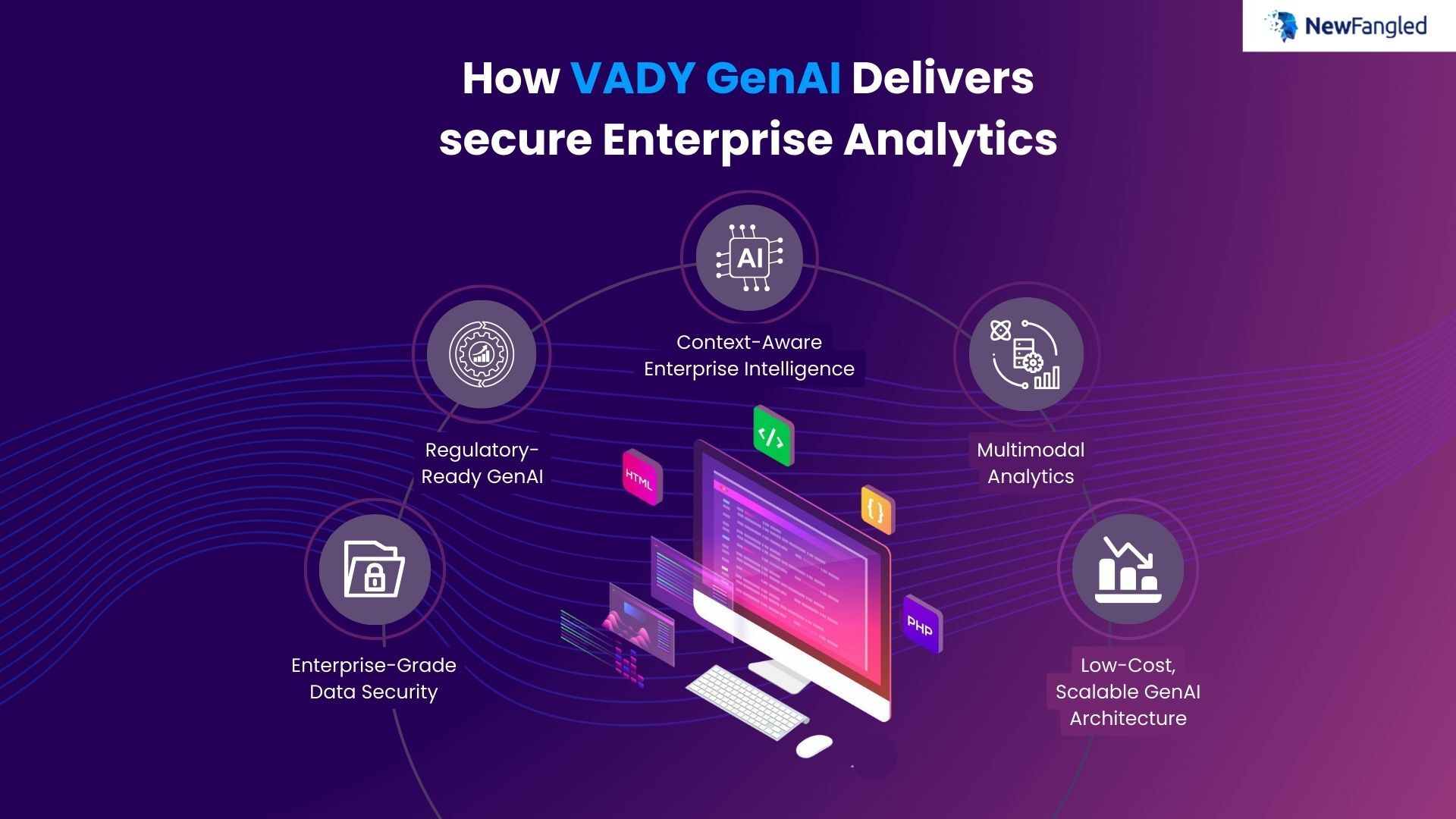
This article investigates why cloud-based GenAI falls short in Enterprise Analytics and introduces VADY, NewFangled’s secure, on-premise GenAI platform, as the architecture that will replace it. VADY, designed to run within business infrastructure, provides natural-language analytics without putting data outside the firewall, transforming GenAI from experimental to trusted, production-ready intelligence.
Problem 1: Data Security & Confidentiality Risks
For enterprises, data is much more than just raw information; it is a critical commercial asset and intellectual property. Financial statements, customer information, operational KPIs, contracts, and strategic insights must be completely within the organization’s control at all times. Any exposure outside of the corporate perimeter creates unacceptable risk.
Cloud-based GenAI systems fundamentally disrupt the trust model. They need sensitive data to be sent to external APIs and processed on infrastructure that the organisation does not own or manage. This raises major concerns about data leakage, unauthorised access, data retention, and long-term loss of control issues that no security or compliance team should ignore.
How VADY – Enterprise Analytics Solves This
VADY is built from the ground up with enterprise-grade security at its core. Instead of depending on public LLMs or GPU-intensive cloud infrastructure, VADY works fully within the organization’s own environment.
Key security principles include:
- No use of public LLMs, eliminating exposure to external models
- No GPU dependency, reducing both risk and infrastructure complexity
- On-premise deployment on company-owned servers
- Strict read-only data access, ensuring source systems remain untouched
Beyond infrastructure-level security, VADY implements fine-grained access control across the Enterprise Analytics lifecycle. Enterprises can control who has access to what, down to the tiniest detail.
This includes:
- Table-level, column-level, and row-level access rules
- Role-based visibility for dashboards and reports
- Controlled access based on user roles, departments, or responsibilities
To enhance secrecy, VADY enables user-configurable data masking and encryption. Sensitive fields can be hidden, anonymised, or encrypted based on user permissions, ensuring that essential information is secure even while insights are created.
The outcome is clear: GenAI-powered Enterprise Analytics that provide intelligence while maintaining security, ownership, and confidentiality.
Problem 2: Compliance & Regulatory Violations
Enterprises operate in highly regulated environments where stringent laws, industry standards, and internal governance frameworks strictly control data handling. Regulations around data residency, privacy, and auditability define where organizations can store data, how they can process it, and who can access it. Any deviation from these requirements exposes enterprises to serious legal, financial, and reputational risks.
Public GenAI systems fail to meet these enterprise-level compliance demands. They frequently transmit data across geographic boundaries, process it through opaque pipelines, and rely on third-party infrastructure that offers little visibility or control. In many cases, these systems provide limited or no audit trails, making it difficult for compliance teams to review, validate, and approve GenAI-driven operations.
For regulated industries including banking, healthcare, manufacturing, and government-linked firms, these gaps pose urgent and unacceptable compliance concerns.
How VADY Solves This
VADY is designed to work entirely inside business compliance restrictions. VADY ensures that data never leaves the organization’s grounds. There is no external processing, third-party access, or concealed data transfer at any point throughout the Enterprise Analytics or insight production process.
Key compliance advantages include:
- On-premise deployment aligned with regulatory and data residency requirements
- Strict access control policies enforced across users, roles, and data assets
- Full alignment with Indian data protection and compliance regulations
- No external model training or data reuse, ensuring complete ownership of enterprise data
Because Newfangled does not access consumer data and VADY operates purely within the company context, compliance and legal departments may confidently examine, validate, and authorise GenAI usage. This establishes VADY as a reliable foundation for deploying GenAI in regulated corporate contexts.
Problem 3: Lack of Contextual Enterprise Understanding
One of the most significant shortcomings of cloud-based GenAI systems is their inability to comprehend enterprise-specific context. Generic models are trained on large amounts of public data and have little understanding of how a specific organisation runs. They are unfamiliar with internal processes, industry-specific terminology, corporate regulations, operational routines, and decision-making frameworks that drive real-world business activities.
As a result, the insights provided by these systems are sometimes superficial, unconnected, or even false, particularly in Enterprise Analytics use cases where context is critical. Without a knowledge of how data links to business rules and operational reality, GenAI outputs fail to provide significant value to enterprise decision-makers.
How VADY Solves This
VADY – Enterprise Analytics is not a general artificial intelligence system. It is built and tailored to each company’s specific operating and industrial requirements. Rather than depending on universal information, VADY creates a client-specific knowledge bank during deployment.
This knowledge bank is created using:
- Internal procedures and operational manuals
- Company policies and standard operating procedures (SOPs)
- Industry-specific terminology and domain expertise
- Business rules and decision logic defined by the client
As users engage with VADY, the system is constantly learning from usage patterns, feedback, and decision results. Over time, this allows VADY to provide increasingly accurate, relevant, and context-aware insights that are consistent with how the organisation really operates.
Problem 4: Poor Multimodal Analytics Support
Enterprise analytics extends far beyond traditional databases. Unstructured and semi-structured sources such as PDFs, Excel and CSV files, reports, operational logs, and supporting documents often contain the most critical insights. These sources provide essential context, explanations, and operational details required for accurate and meaningful analysis.
Most cloud-based GenAI systems fail to reason over organised and unstructured data simultaneously. They can handle text or tables on their own, but they struggle when asked to mix databases, documents, spreadsheets, and business logic in a single analytical workflow. This constraint becomes much more obvious in business applications where Enterprise Analytics must adhere to specified regulations and produce exact, repeatable results.
How VADY Solves This Using Enterprise Analytics
VADY is designed specifically for genuine multimodal analytics. It can read, comprehend, and reason across numerous data types at the same time, enabling organisations to analyse information holistically rather than in silos.
VADY works seamlessly with:
- PDFs and document files
- Excel and CSV spreadsheets
- SQL and other structured databases
- Client-defined business logic and analytical rules
In addition, VADY generates client-specific reports tailored to enterprise needs, including:
- Custom time periods and reporting windows
- Reports based on defined business rules
- Department- or role-specific views
This feature enables organisations to transition from static dashboards and fragmented reports to intelligent, contextual analytics supplied automatically and without manual intervention.
Problem 5: Architecture, Cost & Scalability Issues
Cloud-based GenAI solutions create significant cost and performance uncertainty, making them unsuitable for enterprise analytics at scale. They rely heavily on GPUs, which drives up infrastructure costs, while token-based pricing causes expenses to rise unpredictably as data volume and usage increase. As workloads grow, latency quickly becomes a major issue, often forcing enterprises to invest in high-end infrastructure just to maintain acceptable performance.
This methodology is not sustainable nor cost-effective for organisations that perform Enterprise Analytics on vast datasets, departments, and time-sensitive operations.
How VADY Solves This
VADY was designed from the bottom up for efficiency, scalability, and long-term cost management. It eliminates the need for GPU-intensive processing and does not necessitate costly, high-end servers. nstead, VADY operates on a lightweight architecture while providing significant analytics and reasoning capabilities.
Key advantages include:
- No GPU dependency, significantly reducing infrastructure costs
- No requirement for high-end servers, lowering capital expenditure
- Lightweight deployment, optimized for enterprise environments
- Up to 80% reduction in manual labor, improving productivity across teams
VADY uses a microservices-based architecture that enables linear scaling as enterprise demands grow. The platform delivers high availability and allows teams to scale across departments, data sources, and use cases without compromising performance.
Conclusion: A New Standard for Enterprise Analytics
Cloud-based GenAI demonstrated what was feasible for corporations, but it was never designed to meet the demands of corporate analytics. Security issues, gaps in compliance, a lack of context, limited multimodal assistance, and escalating expenses all pointed to the need for a new strategy.
VADY – Enterprise Analytics represents that new approach.
VADY replaces cloud GenAI with something significantly more practical and powerful since it runs safely within enterprise infrastructure, understands business context, supports multimodal data, and delivers scalable, low-cost intelligence.
This is not GenAI for experimentation.
VADY – Enterprise Analytics built for enterprise decision-making.


I work at NewFangled Vision, a 6-year-old private GenAI startup from India. We build enterprise-grade AI systems without large LLMs or heavy GPU dependence, with a mission to make AI a seamless, must-have capability for every organization—without complexity or hassle.