

Table of Contents
The Truth About Private Enterprise GenAI: Beyond Public AI Security
Introduction: Why “Private” Has Become a Confusing Word
In the last two years, generative AI has transitioned from research laboratories to boardrooms. Tools driven by large language models (LLMs) have demonstrated amazing ability in creating content, answering enquiries, summarising papers, and increasing productivity. As businesses hurried to acquire this technology, a single word appeared everywhere: “Private enterprise GenAI.”
Many leaders formed a straightforward assumption: if an AI system carried the label “private” or “enterprise-grade,” it must be secure, compliant, and suitable for sensitive business applications. In practice, however, many GenAI initiatives have stalled, failed security assessments, or introduced more risk than value. This disconnect did not result from poor decision-making. Instead, it stemmed from misunderstandings about what Private Enterprise GenAI truly entails and how fundamentally it differs from public LLM-based solutions.
This article clarifies the distinction. It discusses why the misconception arises, how public LLMs vary from Private Enterprise GenAI, what genuinely distinguishes GenAI as enterprise-grade, and why businesses increasingly want purpose-built private solutions rather than repackaged public AI.
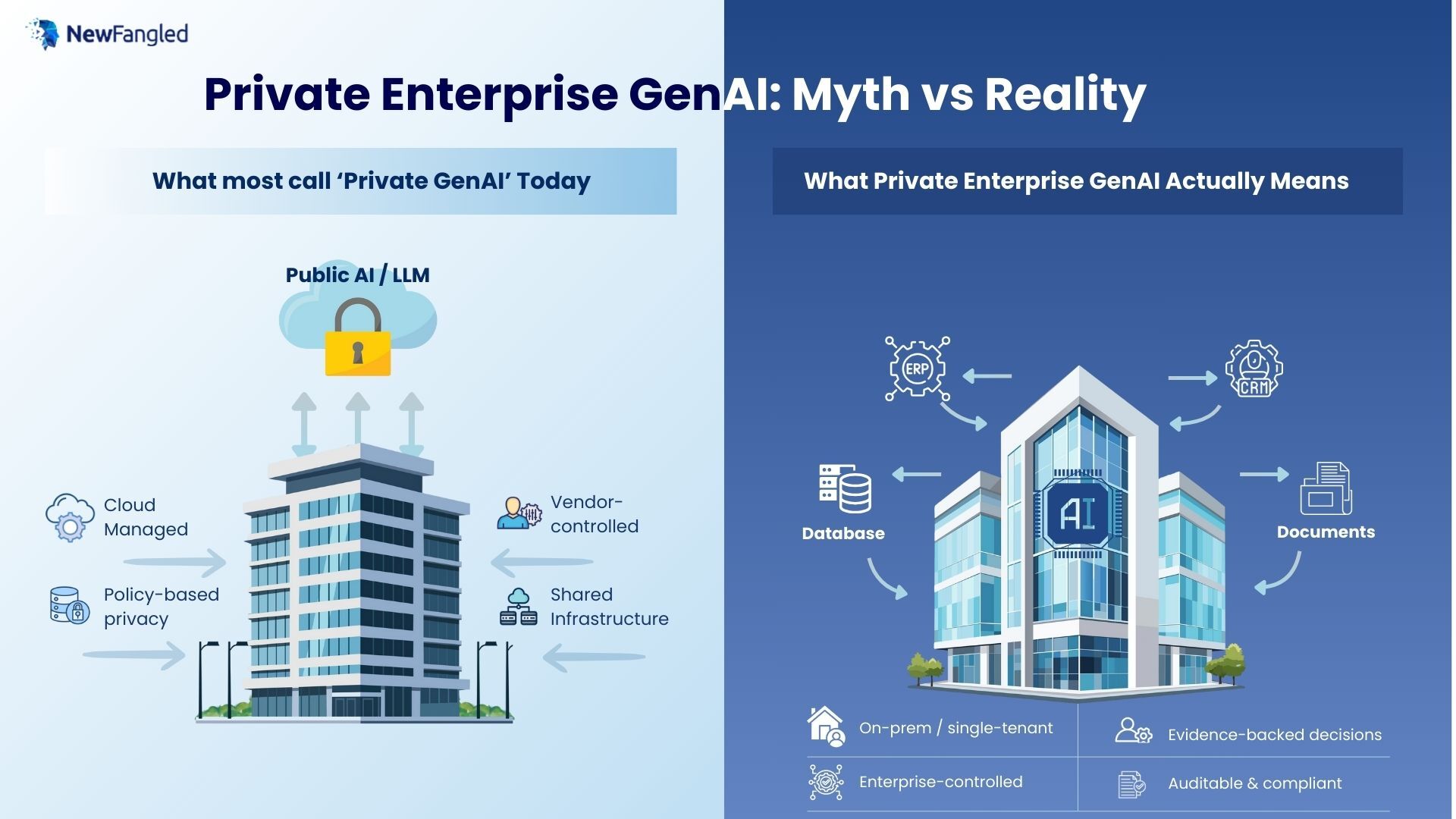
Why This Confusion Exists
The misunderstanding around private enterprise. GenAI has a straightforward history: public GenAI arrived first. Public tools exhibited value rapidly, drew attention, and influenced expectations. Vendors subsequently changed their message to reassure corporations by including terms like private, secure, and enterprise-ready in cloud-based services.
The issue is that various parties understand “private” differently.
- Business leaders heard “safe”
- Legal teams hear “compliant”.
- IT personnel hear “on-premises or isolated”.
- Security teams hear “controlled and auditable”
In practice, these are distinct needs, and many GenAI solutions meet some but not all of them. As a result, organisations frequently assume they have embraced Private Enterprise GenAI, only to realise later that the underlying architecture still acts like public AI in important respects.
What Most People Think “Private GenAI” Means (and Why That’s Incomplete)
When enterprises evaluate GenAI solutions, they often rely on a familiar checklist:
- Our data is not used for training
- It’s protected by SSO and access controls
- It runs in a private cloud or VPC
- The vendor has an enterprise contract
These conditions are necessary, but they do not fully define Private Enterprise GenAI. UI labels or contractual assurances alone do not determine true privacy. Instead, privacy depends on where data flows, how systems process it, and who ultimately controls the infrastructure.
In many cases:
- Prompts are still processed in vendor-managed infrastructure
- Metadata and telemetry still leave the enterprise boundary
- Logs and monitoring data are retained externally
- Control depends on policy promises rather than physical or architectural isolation
For this reason, enterprises must view Private Enterprise GenAI as an architectural and operational decision—not a marketing feature.
Public LLMs vs Private Enterprise GenAI: A Conceptual Difference
People often discuss public LLMs and Private Enterprise GenAI as variations of the same thing. Conceptually, they are not.
Public LLMs are designed to:
- Serve a broad, general audience
- Optimize for language fluency and creativity
- Operate probabilistically
- Learn from massive, shared datasets
- Minimize friction for individual users
Private Enterprise GenAI is designed to:
- Support business decisions and operations
- Prioritize correctness and traceability
- Operate under strict data governance
- Respect regulatory and audit requirements
- Provide accountability when outcomes matter
In short, public LLMs optimize for expression, while Private Enterprise GenAI optimizes for execution.
What Really Makes GenAI “Enterprise-Grade”
Enterprise-grade GenAI is defined not by model size or novelty, but by trustworthiness at scale.
Key characteristics include:
- Data control and residency: Clear understanding of where prompts, embeddings, logs, and outputs reside
- Evidence-backed outputs: Ability to trace answers to source data
- Auditability: Logs and decision trails suitable for compliance and review
- Predictable behavior: Reduced hallucination risk for structured business queries
- Cost transparency: Visibility into infrastructure and operational costs
- Human-in-the-loop controls: Approval workflows for high-impact decisions
Without these elements, GenAI remains an experiment not an enterprise system.
Why Enterprises Need Private Enterprise GenAI: Tool or Necessity?
A common executive question is whether Private Enterprise GenAI is truly necessary, or simply another tool layered onto existing analytics and automation systems.
The answer lies in risk. Enterprises operate in environments where:
- Decisions affect revenue, safety, and compliance
- Errors carry legal and reputational consequences
- Audits and regulatory scrutiny are routine
Public GenAI tools, even when labeled “enterprise,” cannot shoulder this responsibility on their own. Private Enterprise GenAI does not replace human judgment; it augments decision-making in a controlled and defensible manner. For mature enterprises, this capability is not optional it is foundational.
Examples of “Private GenAI”: Myths vs Reality
To understand why clarity matters, enterprises must examine the common assumptions they make about private GenAI deployments. These assumptions are understandable, but they are often incomplete. The following sections outline several widely adopted GenAI deployment patterns in the market, along with the myths and realities associated with each.
Vendor-Hosted Enterprise AI Interfaces
Myth: When enterprises label an AI assistant as “private” or “enterprise-grade,” company data never leaves the organization.
Reality: Most enterprise AI Assistants operate in vendor-managed cloud environments, not inside the organization’s physical infrastructure. While data may be logically isolated, it is not physically isolated. Prompts, metadata, logs, and telemetry typically traverse vendor infrastructure, and configuration errors can expose unintended data paths.
Summary: Many regulated organizations assume cloud-managed Enterprise AI Assistants are equivalent to on-prem deployments. Architecturally, they are not.
Foundation Model as a Service (FMaaS) Platforms
Myth: Using a managed foundation model platform means GenAI can run fully inside the enterprise data center.
Reality: Most managed platforms are cloud-native by default. Achieving true on-prem or hybrid deployment often requires specialized hardware extensions or managed appliances that remain tightly coupled to the cloud provider and under their operational control.
Summary: Cloud dependency is not eliminated; it is extended into the enterprise environment.
Network-Isolated Cloud AI Processing
Myth: If GenAI traffic does not traverse the public internet, data never leaves the enterprise.
Reality: Private networking avoids exposure to the public internet, but it does not change where computation occurs. External cloud data centers still process the data, and compliance relies primarily on contractual agreements rather than physical isolation.
Summary: A private network does not automatically mean a private compute.
Enterprise-Licensed AI Services
Myth: Enterprise licensing guarantees that vendors never see or process customer data.
Reality: In most SaaS models, data is still processed within vendor-controlled environments. Privacy relies on policies, terms, and trust rather than ownership of the infrastructure itself.
Summary: Legal assurances are often mistaken for technical guarantees.
Policy-Constrained GenAI Models
Myth: Models designed with safety and alignment in mind do not produce incorrect or misleading outputs.
Reality: All large language models remain probabilistic systems. They can generate confident but incorrect responses, particularly when applied to structured business data or decision-critical workflows.
Summary: For finance, operations, and compliance, correctness matters more than conversational alignment.
The Core Lesson: Private Is Not a Checkbox
Across all examples, one lesson stands out: “private” is not a binary attribute. Organizations can enforce privacy through policy while still relying on public architectures. They can license enterprise-grade solutions that remain operationally opaque. They can deploy powerful systems that are unsafe for real business decisions. True Private Enterprise GenAI prioritizes control, accountability, and trust not just performance.
Conclusion: Clarity Before Adoption
As enterprises move from experimentation to execution, understanding Private Enterprise GenAI is no longer optional.
The right question is not “Which AI is smartest?”
It is “Which AI can we trust with real decisions?”
Private Enterprise GenAI represents a shift from general-purpose intelligence to responsible, enterprise-ready systems. Organizations that recognize this distinction early will move faster, safer, and with greater confidence than those chasing labels.
Clarity not hype is the foundation of successful GenAI adoption.


I work at NewFangled Vision, a 6-year-old private GenAI startup from India. We build enterprise-grade AI systems without large LLMs or heavy GPU dependence, with a mission to make AI a seamless, must-have capability for every organization—without complexity or hassle.