

Table of Contents
and Manual vs AI Reporting: What Enterprises need in 2026
Introduction: When the talk about Manual vs AI Reporting comes in.
Let’s take a look at a typical boardroom conversation. It usually starts out the same way. A CFO goes to a meeting once a month to review things. The reports are finally done. The team has been busy for the past few days getting data from ERP systems, cleaning up spreadsheets, checking numbers, and getting ready for presentations.
The figures seem to be right. But there is a quiet, unspoken inquiry in the room: “Is this still important?” The business will have already moved on by the time the report is done. Changes have happened in revenue trends. The costs have gone up. The market is different. And what about choices? They are being made based on what was, not what is. This is when the talk about Manual vs AI Reporting comes in.
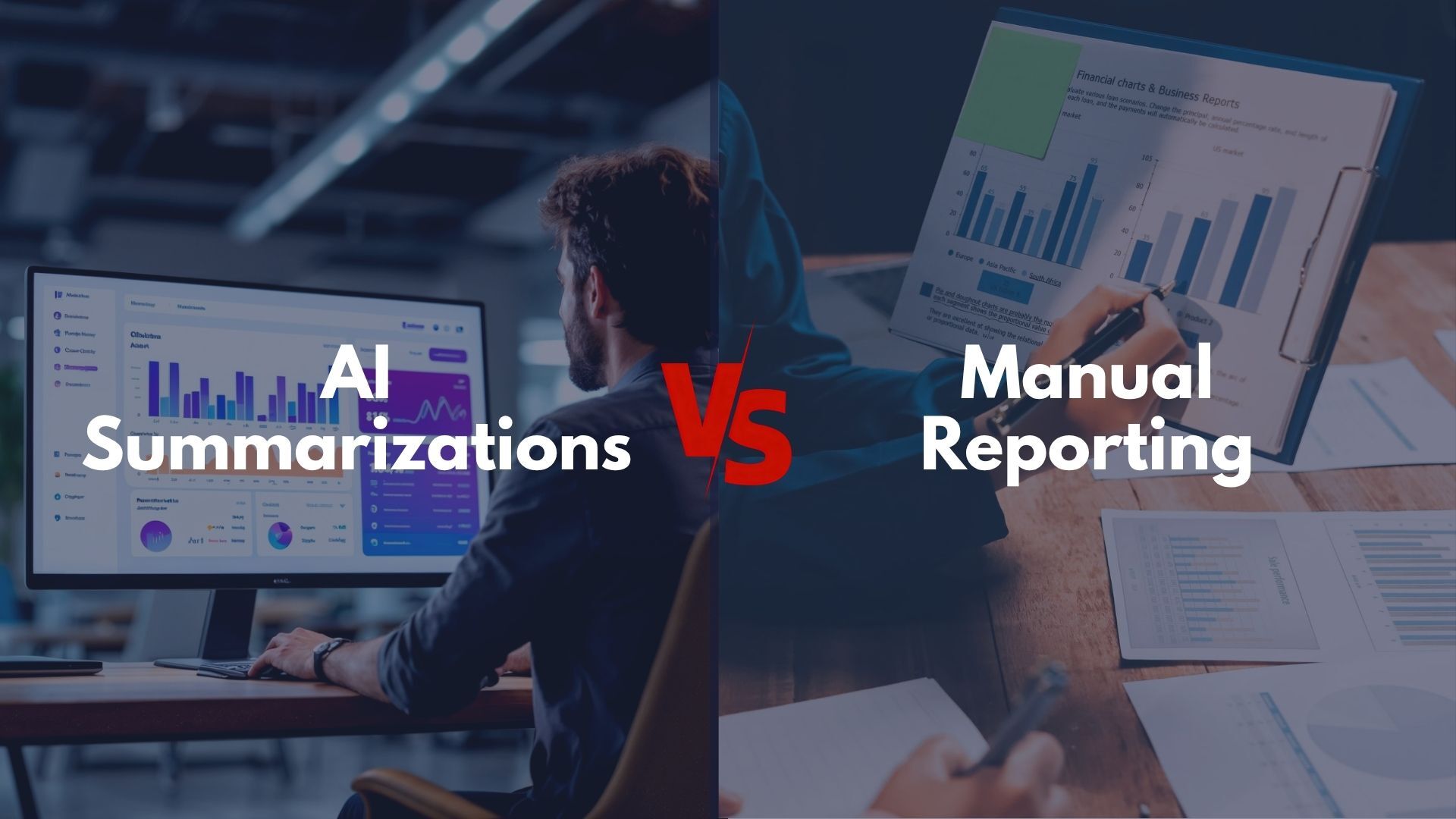
What Is Manual vs AI Reporting
Let’s make this easier. This is what manual reporting looks like in most businesses today:
- Data is stored in more than one system.
- Teams take it out by hand
- You can make reports in Excel or BI tools.
- Insights depend on how others understand them.
It works, but it’s slow, takes a lot of labour, and is hard to grow. Now picture a different situation where AI is reporting:
- Systems automatically send data to each other.
- Reports are made right away
- Insights come to light right away
- Teams don’t prepare; they make decisions.
This is the main difference between manual and AI reporting: effort-driven reporting and system-driven intelligence.
Why Manual Reporting Starts Breaking Quietly, Then Suddenly
At first, reporting by hand works. It’s all under control with a tiny crew, manageable data, and a few reports. But then the company gets bigger. More systems means more information and More people with a stake which makes it More complicated. And slowly, the cracks start to show. A finance leader might see:
- It takes longer to write reports.
- Teams are spending more time making sure the data is correct.
- The numbers in different reports are not exactly the same.
- Data isn’t ready, thus decisions are taking longer.
Nothing breaks during the night. But after a while, doing reports by hand slows things down. This is the stage in the path from Manual vs AI Reporting is when reporting goes from being a helpful tool to being a hindrance to the business.
What Changes When AI Enters the System
Now consider a different conversation. The same CFO walks into the meeting but this time, the dashboard is already live. The data is current. Not from last week. Not from yesterday. From now.
Instead of asking, “What happened?” the conversation shifts to: “What should we do next?”
This is what AI reporting changes. It removes the delay between data and decision. It connects systems, automates workflows, and continuously updates insights. In the context of manual vs AI reporting, this is not just improvement it’s a structural shift.
Manual vs AI Reporting: A Side-by-Side Reality Check
To make this tangible, let’s compare both approaches directly:
| Feature | Manual Reporting | AI Reporting |
| Speed | Slow (days/weeks) | Real-time |
| Accuracy | Error-prone | High accuracy |
| Effort | High manual effort | Minimal effort |
| Insights | Limited | Automated insights |
| Scalability | Low | High |
| Dependency | High (people-driven) | Low (system-driven) |
The Hidden Cost Conversation No One Talks About
At first glance, it looks like manual reporting is cheap. There isn’t a big investment. No changes to the system. Just individuals doing their jobs. But take a deeper look how much does it cost to:
- Teams spending days getting reports ready?
- Mistakes that need to be fixed?
- Decisions put off because there isn’t enough data?
- Did you miss out on chances because insights arrived too late?
These are genuine things, even though they aren’t apparent. Now, look at that and compare it to AI reporting. Yes, you have to put money down up front. Putting everything together. Setting up the system. But the equation varies with time. Less work by hand. Decisions are made faster. Better results.
This is when the argument regarding Manual vs AI Reporting shifts from cost to value.
A Moment of Reflection: When Does Manual vs AI Reporting Stop Making Sense?
Not all businesses require AI right away. In truth, there are still times where manual reporting works:
- Small groups with little data
- Basic reporting needs
- Businesses in their early stages
In certain situations, being able to change is more important than automation.But for most businesses, there comes a time when the issue switches from “Can we get by with manual reporting?” to “How long can we afford to?” That’s the turning point.
Real Enterprise Scenarios: Where the Shift Becomes Obvious
It’s not in theory, but in real-life situations that the distinction between manual and AI reporting is most clear. These are problems that many businesses already have to deal with, as when reporting is late, data is scattered, and visibility is low, which makes it hard to make decisions.
Scenario 1: The Monthly MIS Cycle
For many businesses, the monthly MIS process is a well-known part of their routine. As the month comes to an end, financial teams start putting together information from ERP systems, spreadsheets, and reports from other departments. This procedure usually includes several rounds of data extraction, validation, reconciliation, and formatting.
This cycle usually lasts 3 to 5 days, but it might take longer for big companies. During this time, teams are just working on making reports, not looking at them. The business has already moved on by the time the MIS report gets to the top. Market conditions may have altered, operational indicators may have changed, and people are making decisions based on old knowledge.
This whole cycle changes with AI reporting. Data is constantly being combined and processed in real time. Reports are made automatically, so there is no need to combine them by hand.
The result:
- Time to report cut by 60–80%
- Shorter cycles for closing finances
- Insights are available right away
The question changes from “Is the report ready?” to “What does the data say right now?”
Scenario 2: Budget vs Actual Reviews
Budget vs. real analysis is very important for keeping track of finances, although it sometimes takes longer with manual systems. Only after reports are finished, which can take days or weeks, do teams compare anticipated budgets to actual performance.
This delay makes it harder to take quick action to fix things. The problem may have already gotten worse by the time a variant is found. AI reporting transforms this whole thing. The system doesn’t just compare performance against budgets every now and then; it does it all the time. You may see differences right away, and oddities are automatically marked.
For instance, if a department’s operating costs go beyond the budget limit, the system will show the difference in real time.
Outcome:
- Finding differences right away
- Actions to fix things faster
- Better money management
This changes budget tracking from a look-back activity into a way to keep an eye on things.
Scenario 3: Cash Flow Visibility
One of the most important things that finance leaders have to do is control cash flow. But in many businesses, different systems and teams don’t always have a clear picture of cash flow. To do manual reporting, you have to combine data from bank statements, ERP systems, and operational inputs. This typically leads to delayed or inadequate visibility, which makes it hard to manage liquidity well.
AI reporting keeps track of and updates cash flow data from all sources all the time. Finance teams can see all of the money coming in and going out, as well as the current cash position, in one place and in real time. For example, a CFO can quickly check the liquidity of all business units without having to wait for reports at the end of the day or week.
The result:
- Seeing cash flow in real time
- Better planning for liquidity
- Less risky financially
Instead of waiting for cash problems to happen, businesses may plan for and deal with them ahead of time.
Scenario 4: Revenue Forecasting and Planning
Revenue forecasting is traditionally based on historical data and static assumptions. While this approach provides a baseline, it often fails to capture dynamic market conditions. In manual systems, forecasts are updated periodically—monthly or quarterly—making them less responsive to real-time changes.
AI reporting introduces continuous forecasting. By analyzing patterns across historical data, customer behavior, and external factors, AI models update forecasts dynamically as new data becomes available. For example, a sudden change in demand patterns can be reflected immediately in revenue projections, enabling faster strategic adjustments.
Result:
- 20–30% improvement in forecast accuracy
- More reliable financial planning
- Better alignment between strategy and execution
Forecasting evolves from static prediction to adaptive intelligence.
Scenario 5: Expense Monitoring and Cost Control
Another area where manual reporting leaves gaps is in expense management. In a lot of companies, spending reviews occurs after reports are made, which makes it hard to find problems with time. Tracking things by hand also makes it harder to find strange things, like spending patterns that are out of the ordinary or costs that go over budget.
AI reporting lets you keep an eye on spending in all categories and departments all the time. The system automatically finds things that are out of the ordinary and marks them for review. For example, if one cost center suddenly has a lot more expenses than usual, the system will immediately flag it so that teams may look into it and fix the problem.
Outcome:
- Finding cost problems early on
- Better control of expenses
- Less money spent on things that aren’t needed
This changes how you handle expenses from tracking them after they happen to optimising them before they happen.
Conclusion: The Choice Is Not About Tools It’s About Systems
People often talk about Manual vs AI Reporting as a choice between technologies. But it’s not. It’s about how your business is set up to work. Manual reporting works until it doesn’t. AI reporting needs money, but it lets you grow. Companies that see this early move faster. They make systems that let data flow smoothly, give insights right away, and help people make smart choices.
This change is already clear across businesses at NewFangled Vision. Reporting is no longer seen as a job; it’s rather a mechanism that helps people make decisions in real time. And that’s what matters in the end. Not how reports are made. But how choices are made.


I work at NewFangled Vision, a 6-year-old private GenAI startup from India. We build enterprise-grade AI systems without large LLMs or heavy GPU dependence, with a mission to make AI a seamless, must-have capability for every organization—without complexity or hassle.