

Table of Contents
The Enterprise Journey to GenAI: From Excitement to Reality
Across industries, the Businesses debate about Generative AI started with real optimism. Boards, executive leadership, and innovation teams saw GenAI as a game changer capable of revolutionising how businesses run and compete. The promise was enticing: faster access to insights, better decision-making, less operational effort, and verifiable productivity gains across functions. GenAI was positioned for the modern enterprise as a catalyst for accelerated digital transformation and strategic differentiation, rather than another incremental technological upgrade.
Early protests supported this optimism. Natural language interfaces, rapid document summaries, and conversational analytics made powerful AI feel intuitive and practical. Complex data might be queried in straightforward English, lowering adoption hurdles throughout the business. As a result, for many Leaders, the conversation swiftly moved from whether GenAI will be embraced to how quickly it could be deployed at scale.
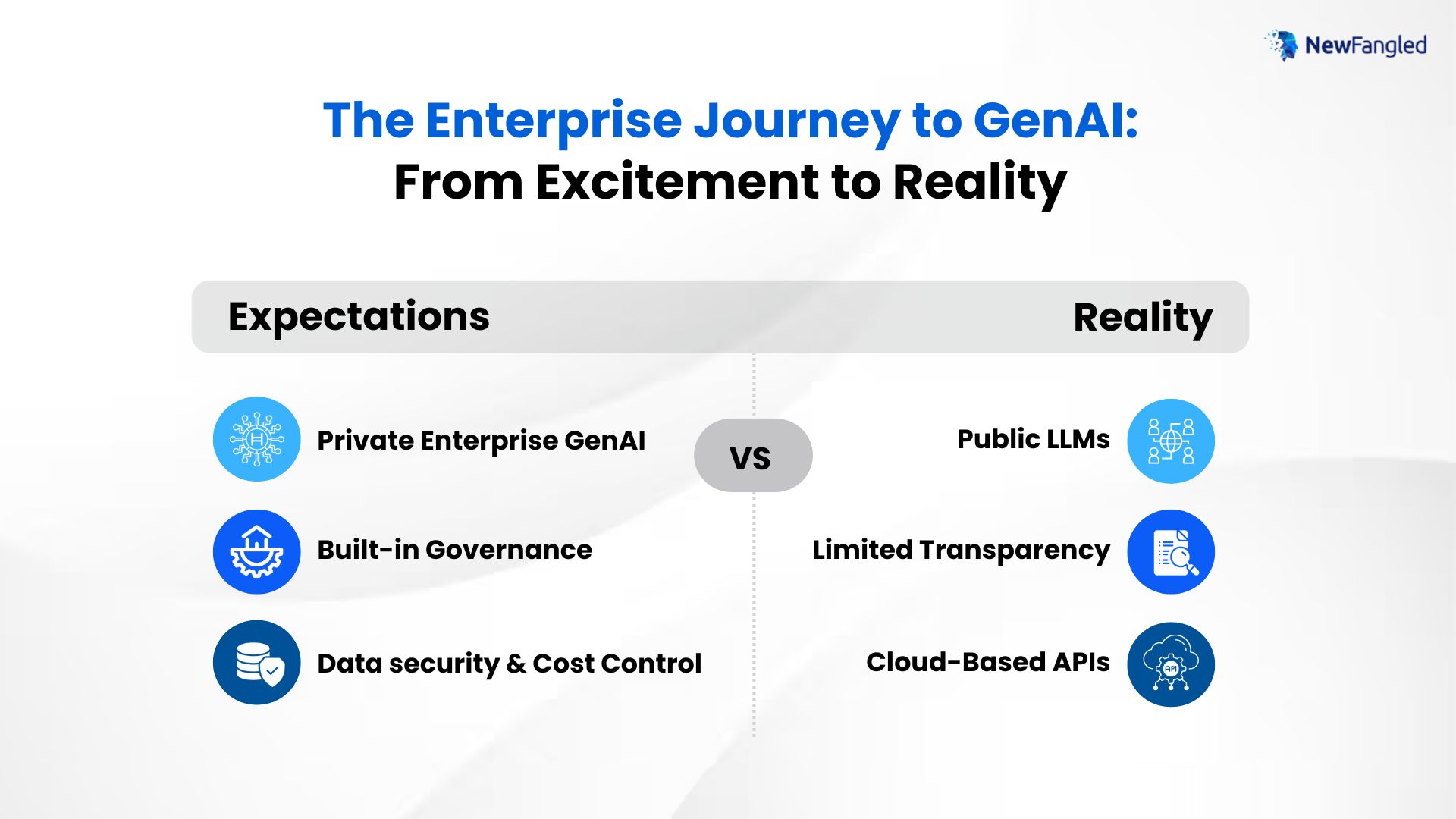
The Enterprise Chose the Easy Path
When Businesses made their first practical move towards GenAI adoption, most chose the same approach: cloud-based LLM APIs. Platforms like ChatGPT, Copilot, and Amazon Q provide a highly appealing value proposition to the enterprise.
They removed the requirement for:
- There is no infrastructure to manage.
- Quick onboarding and fast experimentation
- Access to continuously developing models.
- immediate scalability
This technique greatly decreased friction in innovation and digital teams. Pilots could be launched in a matter of weeks, and early proofs of concept showed immediate tangible value. From the outside, Enterprise GenAI adoption appeared effortless, reinforcing the belief that cloud APIs were the fastest and most efficient way ahead.
Challenge Enterprise GenAI Faced After Experimentation
The Enterprise problem emerged when GenAI progressed beyond experimental and closer to industrial application. When models began interacting with internal documents, sensitive customer information, and fundamental operational operations, the risk profile shifted dramatically. What was once a controlled experiment now had immediate ramifications for data security, regulatory compliance, and business continuity, causing Businesses to rethink their plans.
At this point, Enterprises no longer treated GenAI as an innovation initiative. They elevated it to a core business system, subjecting it to strict security reviews, compliance validations, audit requirements, and financial oversight. Ownership shifted from product and innovation teams to leadership, risk and compliance functions, and, in regulated industries, to external regulators as well.
This is where excitement met reality.
The Trust Gap of An Enterprise With Cloud GenAI
Businesses started to see a growing trust gap as GenAI use increased, which could no longer be disregarded. What was workable in pilots grew progressively complex at scale, revealing structural flaws in the cloud-first strategy.
Key trust challenges for the Businesses included:
- Loss of data control: Each business prompt or query sent to a cloud API involved sensitive data that crossed organisational borders, generating worries about confidentiality and ownership.
- Rising compliance exposure: Regulations in regulated industries such as banking, insurance, healthcare, and government necessitate explainability, audit trails, and data residency capabilities, which generic cloud APIs struggle to provide consistently.
- Limited customization: Public LLMs are designed for broad, general-purpose usage and do not fully conform with Enterprise-specific policies, procedures, or institutional knowledge.
- Unpredictable cost structures: Usage-based API pricing models grow quickly, making long-term budgeting, forecasting, and financial oversight problematic.
Individually, each of these issues is manageable. Collectively, they cause friction, slowing Enterprise GenAI adoption and forcing leadership to reconsider trust, control, and sustainability.
What the Data Says About this Hesitation
This Businesses hesitation is supported by real-world evidence Like :
- Gartner reports that 73% of enterprises have had at least one AI-related security incident in the last year.
- According to McKinsey, 47% of businesses data leaders identify data privacy as the key reason AI projects have yet to go into production.
- 72% of organizations rank data privacy as a top concern in GenAI adoption, a sharp increase highlighted in Deloitte surveys.
These figures show a continuous pattern: Enterprise GenAI initiatives do not fail owing to a lack of ambition or technological capacity. They are hesitating because the trust prerequisites have not been reached.
Enterprise Resistance? or Is It Responsibility?
It is critical to capture this moment perfectly. Businesses are not resisting GenAI adoption; rather, they are acting responsibly. The hesitancy observed across industries indicates a thoughtful and essential risk assessment, rather than a lack of vision or ambition.
Leaders are responsible for preserving consumer data, satisfying legal and compliance requirements, managing financial risk, and maintaining the organization’s brand. In this setting, prudence is not an impediment to innovation; rather, it is necessary for deploying technology at scale without unexpected repercussions.
Businesses must have confidence in governance, security, and operational management before GenAI can progress beyond testing. Without these foundations, implementing GenAI extensively would pose risks that no responsible businesses can afford.
A Turning Point in the Enterprise GenAI Journey
Businesses are now at an inflection point. The conversation is shifting from “How fast can we deploy GenAI?” to “How do we deploy GenAI responsibly at Enterprise scale?” This shift reflects growing awareness that speed alone does not equate to success when GenAI begins to influence core operations, customer interactions, and regulated processes.
This marks a transition:
- From tools to platforms
- From speed to sustainability
- From experimentation to institutional intelligence
In this next phase, Enterprises will not define success by deploying the largest or most powerful GenAI models. Instead, they will shape outcomes through architectural decisions that embed trust, governance, and accountability by design. Businesses that succeed will deliberately prioritize control, responsibility, and risk management alongside technological capability.
Conclusion
Enterprises have moved beyond the early excitement and experimentation of GenAI. Today, they must actively balance innovation with responsibility, ambition with governance, and technological capability with trust. As organizations integrate GenAI more deeply into business operations, leaders are rethinking not only what they can deploy, but what they can sustain at scale. Business decision-makers now shape GenAI strategies based on accountability, risk ownership, and long-term impact, rather than prioritizing speed alone.


I work at NewFangled Vision, a 6-year-old private GenAI startup from India. We build enterprise-grade AI systems without large LLMs or heavy GPU dependence, with a mission to make AI a seamless, must-have capability for every organization—without complexity or hassle.