

Table of Contents
4 Private Enterprise GenAI Models: Cloud, Hybrid, Dedicated, On-Prem
As organisations speed their adoption of generative AI, the necessity for secure and controlled deployment models grows. Many organisations choose “private” solutions, believing that enterprise licensing or cloud isolation ensures complete governance and compliance. However, the situation is more complicated. Private Enterprise GenAI Models comes in a variety of deployment Architecture, each with varying levels of control, accountability, and operational maturity.
Understanding Private Enterprise GenAI Architecture is crucial for executives dealing with regulatory challenges, security concerns, and long-term digital transformation objectives. Rather than perceiving privacy as a binary quality, company executives must consider how architectural choices affect data sovereignty, governance, and risk exposure.
This article presents a structured architecture that defines four stages of Private Enterprise GenAI Model: cloud-managed, hybrid, dedicated, and on-premises installations. Understanding these models allows organisations to better match their AI strategy with enterprise governance requirements and operational realities.
Why Private Enterprise GenAI Models Requires Strategic Clarity
Enterprise AI usage has progressed beyond experimental. Organisations today expect generative AI to help with fundamental business workflows, decision-making processes, and operational efficiencies. As these technologies grow more deeply interwoven into company operations, the architecture that supports them becomes a strategic priority.
Many manufacturers align their systems as “private,” although these terms frequently relate to policy-based safeguards rather than actual architectural control. A thorough understanding of Private Enterprise GenAI Architecture enables businesses to differentiate between logical isolation and physical governance.
Several factors contribute to the growing importance of Private Enterprise GenAI Architecture.
- Increased regulatory scrutiny of data processing.
- Rising cyber-threats.
- The requirement for auditability and accountability in AI-powered judgements.
- Executives expect trustworthy automation.
Organisations that do not examine Private Enterprise GenAI Architecture risk implementing solutions that cannot meet compliance or governance needs as they grow.
Introducing the Four Architecture of Private Enterprise GenAI Models
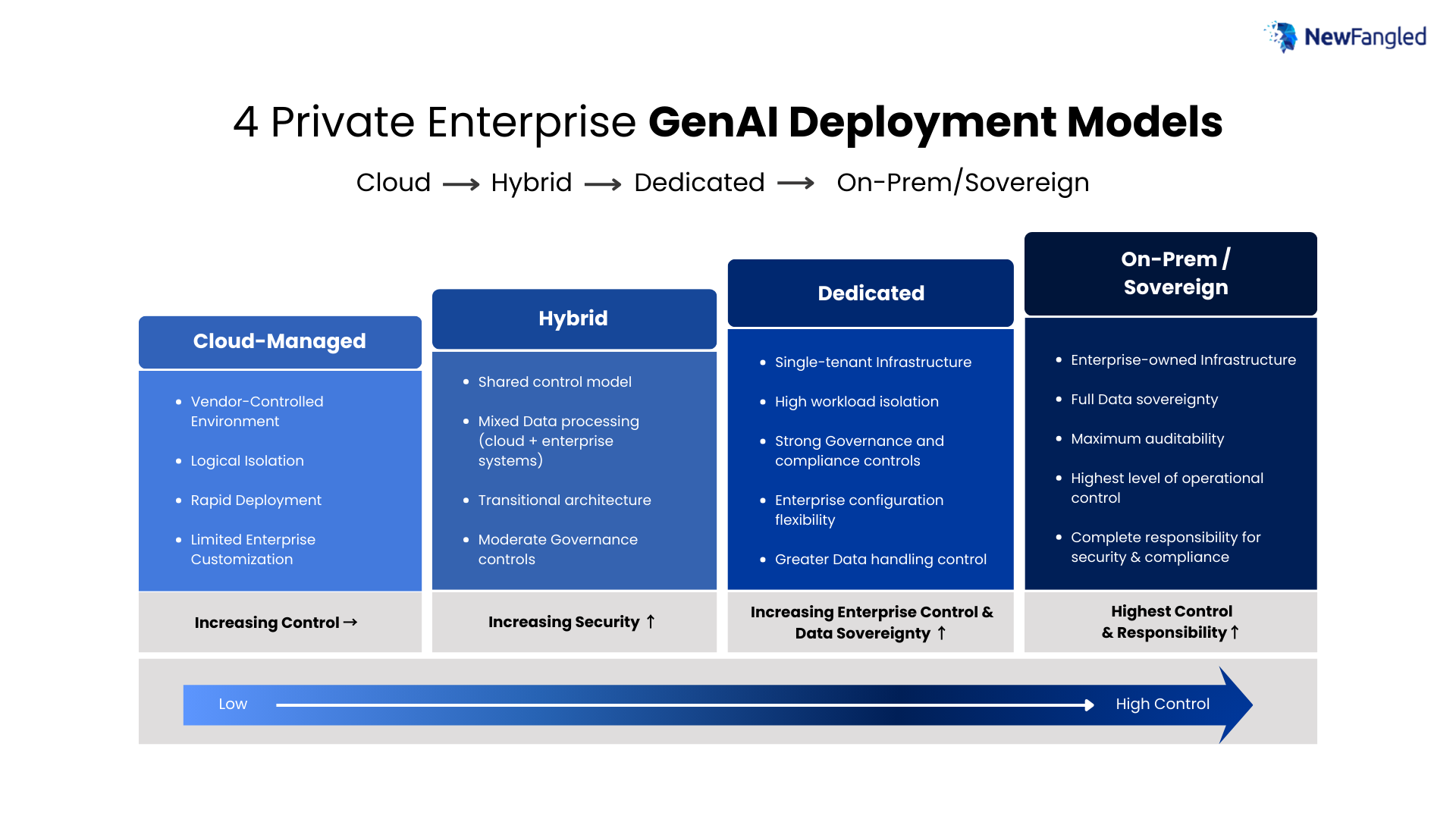
Private Enterprise GenAI Architecture can be categorized into four primary deployment models. These models represent increasing degrees of enterprise control, operational responsibility, and architectural complexity.
- Cloud-Managed Private Enterprise GenAI Architecture
- Hybrid Private Enterprise GenAI Architecture
- Dedicated Private Enterprise GenAI Architecture
- On-Prem or Sovereign Private Enterprise GenAI Architecture
Each model offers advantages and trade-offs. Choosing the appropriate model depends on data sensitivity, internal expertise, and long-term strategic priorities.
Cloud vs Hybrid vs Dedicated vs On-Prem: Key Differences
Understanding Private Enterprise GenAI Architecture requires more than definitions. Enterprise leaders must evaluate how each deployment model differs across control, security, operational responsibility, and long-term scalability.
The table below summarizes the key distinctions between the four models of Private Enterprise GenAI Architecture.
| Dimension | Cloud-Managed | Hybrid | Dedicated | On-Prem / Sovereign |
| Infrastructure Ownership | Vendor-controlled | Shared control | Single-tenant vendor infrastructure | Fully enterprise-owned |
| Data Processing Location | External cloud | Mixed (internal + external) | Isolated cloud environment | Entirely on enterprise premises |
| Data Sovereignty | Limited | Moderate | High | Maximum |
| Regulatory Alignment | Contract-based | Policy + architecture dependent | Strong | Strongest |
| Operational Responsibility | Vendor-led | Shared | Shared but higher enterprise oversight | Enterprise-led |
| Vendor Dependency | High | Moderate-High | Moderate | Low |
| Deployment Speed | Fast | Moderate | Moderate | Slower |
| Cost Structure | Subscription-based | Variable | Higher infrastructure cost | Capital + operational investment |
| Auditability & Traceability | Limited visibility | Improved visibility | High visibility | Full transparency |
| Security Posture | Logical isolation | Mixed isolation | Physical and logical separation | Full architectural isolation |
| Scalability | Highly scalable | Scalable with coordination | Scalable with planning | Scalable with infrastructure expansion |
| Best Fit For | Early adoption, low-risk data | Transitional governance needs | Regulated industries | High-sensitivity, compliance-heavy sectors |
Model 1: Cloud-Managed Private Enterprise GenAI Architecture
Cloud-managed Private Enterprise GenAI Architecture represents the most accessible entry point for organizations adopting enterprise AI. In this model, vendors provide infrastructure, scalability, and operational management while offering logical data isolation.
Architecture Characteristics: –
- AI computation occurs within vendor-managed cloud infrastructure.
- Enterprise data is logically separated from other tenants.
- Telemetry, prompts, and system logs may traverse external environments.
- Governance relies heavily on vendor policies and agreements.
Advantages:-
- Rapid deployment.
- Minimal internal infrastructure requirements.
- Lower operational overhead.
Trade-offs:-
- Limited architectural ownership.
- Continued vendor dependency.
- Potential regulatory challenges in highly sensitive industries.
This model is best suited for early-stage adoption or non-sensitive use cases.
Model 2: Hybrid Private Enterprise GenAI Models
Hybrid Private Enterprise GenAI Architecture combines enterprise-controlled environments with external processing capabilities. This model allows organizations to retain certain datasets internally while leveraging external infrastructure for AI workloads.
Architecture Characteristics:-
- Sensitive data may remain on-prem.
- AI processing may occur in controlled cloud segments.
- Private networking may avoid public internet exposure.
- Governance responsibilities are shared.
Advantages:-
- Increased flexibility.
- Partial data sovereignty.
- Gradual path toward stronger architectural control.
Trade-offs:-
- Increased complexity.
- Data movement between environments.
- Governance coordination challenges.
Many enterprises view hybrid Private Enterprise GenAI models as a transitional phase toward deeper control.
Model 3: Dedicated Private Enterprise Deployment
Dedicated Private Enterprise GenAI models allocates isolated infrastructure exclusively for one organization. Unlike shared cloud environments, this model provides stronger separation and enhanced governance visibility.
Architecture Characteristics:-
- Isolated compute environments.
- Stronger separation from multi-tenant infrastructure.
- Enhanced configuration control.
- Greater governance visibility.
Advantages:-
- Improved security posture.
- Reduced cross-tenant risk.
- Enhanced compliance alignment.
Trade-offs:-
- Higher cost.
- Greater operational oversight requirements.
This approach is common in regulated industries where governance requirements exceed the capabilities of standard cloud deployments.
Model 4: On-Prem / Sovereign Private Enterprise GenAI
Models
On-prem deployment represents the highest maturity level of Private Enterprise GenAI Architecture. In this model, enterprises maintain full ownership of infrastructure and data processing.
Architecture Characteristics:-
- AI computation occurs entirely within enterprise-controlled infrastructure.
- No external data processing ( unless the enterprise requires it to be configured)
- Full ownership of governance and configuration.
- Complete auditability.
Advantages:-
- Maximum data sovereignty.
- Strongest compliance alignment.
- Minimal external dependency.
Trade-offs:-
- Infrastructure investment required.
- Greater operational responsibility.
Some enterprise platforms, such as VADY, demonstrate how conversational enterprise GenAI may operate in restricted contexts while remaining usable and secure. Such models are strongly aligned with higher-control deployment strategies because they integrate privacy directly into system architecture rather than depending merely on policy assurances.
Common Misconception: “Private” Does Not Automatically Mean On-Prem
A common misperception is that any solution labelled private immediately qualifies as on-premises or completely managed. In reality, architectural design, not marketing terminology, determines privacy. Cloud-based models may provide strong policy assurances without requiring full infrastructure ownership. Hybrid models provide more control but do not eliminate external dependencies.
Understanding Private Enterprise GenAI Architecture helps executives avoid misaligned expectations.
Strategic Implications for Enterprise Leaders
Choosing the right Private Enterprise GenAI models requires alignment with:
- Data sensitivity levels.
- Regulatory obligations.
- Risk tolerance.
- Internal technical maturity.
- Long-term AI roadmap.
Enterprises must assess not only performance capabilities, but also infrastructure ownership, governance transparency, and auditability. Organisations that view architecture as a strategic decision rather than a procurement checkbox are better positioned to achieve long-term AI adoption.
Decision Questions for CxOs Evaluating Private Enterprise GenAI Models
Executives should ask:
- Where does computation physically occur?
- Who controls infrastructure and system configuration?
- What data leaves the enterprise boundary?
- How are logs and telemetry managed?
- Can outputs be audited and traced to source data?
- Does this deployment model align with long-term governance goals?
These questions reveal the true privacy posture of any GenAI solution.
Conclusion
Private Enterprise GenAI models includes a variety of deployment modes, ranging from cloud-managed ease to full sovereign sovereignty. Understanding these four models enables businesses to balance innovation, governance, and long-term resilience. Finally, enterprise AI success is dependent on architectural clarity rather than model intelligence alone.


I work at NewFangled Vision, a 6-year-old private GenAI startup from India. We build enterprise-grade AI systems without large LLMs or heavy GPU dependence, with a mission to make AI a seamless, must-have capability for every organization—without complexity or hassle.