

Table of Contents
How to Choose Enterprise AI Platform: 9 Critical Questions Every CXO Must Ask
Introduction
Understanding how to choose enterprise AI platform has become one of the most important decisions for modern organizations. What once appeared to be a straightforward technology selection has now evolved into a long-term architectural commitment that impacts cost, scalability, and operational efficiency.
Many businesses begin their journey by assessing features, model capabilities, and vendor demos. However, these variables rarely mirror what occurs in production. The key problem in selecting an enterprise AI platform is understanding how systems act at scale, as data expands, workflows expand, and governance requirements become crucial.
The difference between a successful deployment and an expensive experiment often comes down to how well the platform aligns with enterprise realities. This is why CXOs must move beyond surface-level evaluation and adopt a structured approach to decision-making.
Why Most Decisions on How to Choose Enterprise AI Platform Fail
A key reason organizations struggle with choosing an enterprise AI platform is that decisions are often made based on short-term validation rather than long-term sustainability.
Three patterns commonly lead to failure:
- Demo-driven decisions : Platforms are selected based on impressive prototypes that do not reflect production complexity
- Underestimating system cost : Focus remains on model pricing while ignoring data, orchestration, and governance overhead
- Lack of architectural thinking : AI is treated as a tool rather than an integrated system
As a result, enterprises encounter unexpected complexity when scaling. Understanding how to choose enterprise AI platform requires shifting from feature comparison to system-level evaluation.
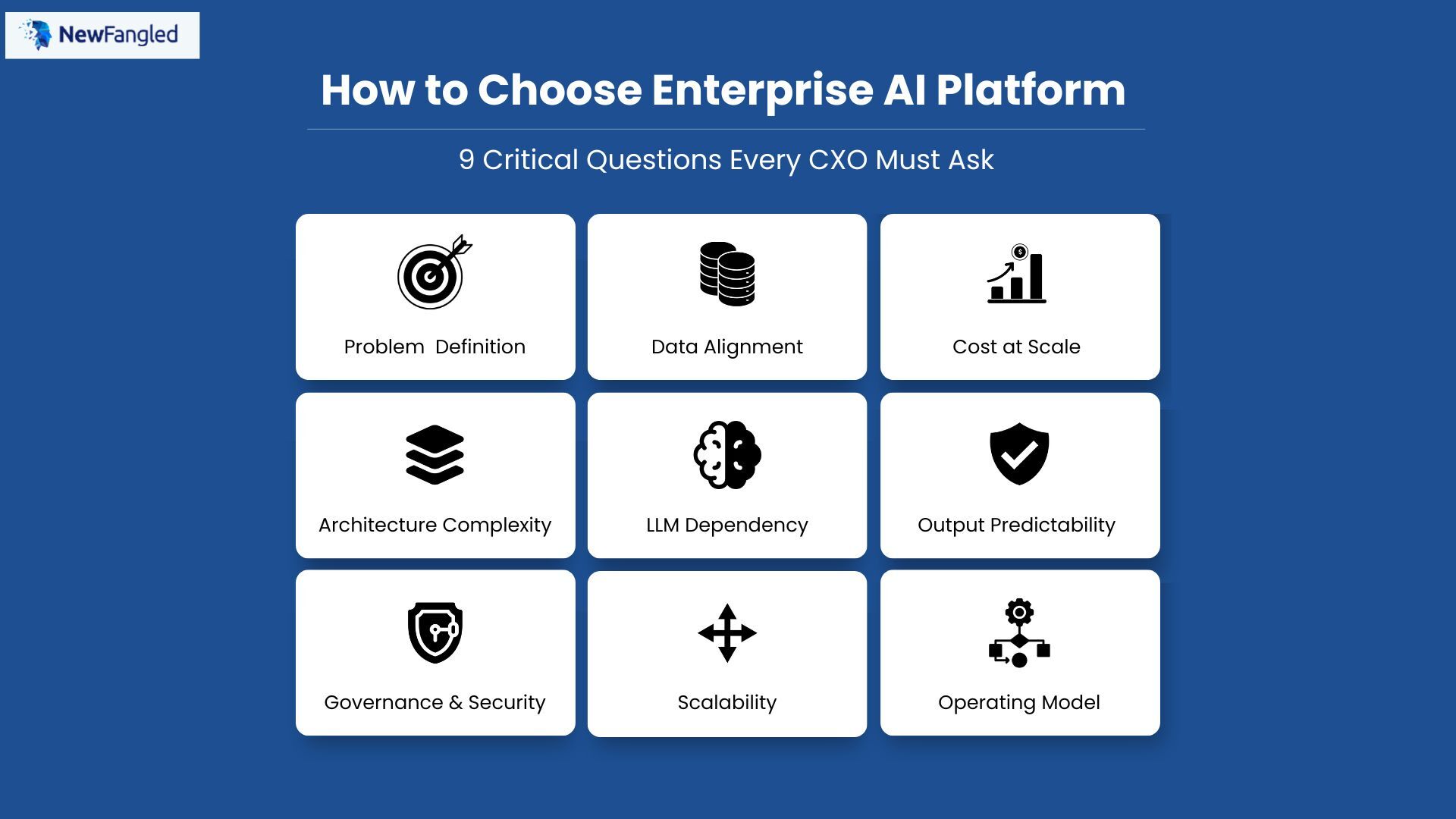
The 9-Question Framework for How to Choose Enterprise AI Platform
To make better decisions, CXOs need a structured framework. The following nine questions provide a practical approach to choose enterprise AI platform in real-world enterprise environments.
1. What Problem Are You Actually Solving?
The first step in how to choose enterprise AI platform is to clearly define the business problem. Many organizations begin with a vague objective such as, “We need AI,” without identifying what they are actually trying to solve. This often leads to misaligned platform decisions and unclear outcomes.
Instead, enterprises should take a structured approach by asking:
- What specific business outcome are we trying to achieve?
- Is this primarily a decision problem, an automation problem, or a knowledge problem?
- What measurable impact should this solution deliver?
By answering these questions early, organizations can narrow down the type of platform that best fits their needs. Without this clarity, platform selection becomes driven by features rather than business value. As a result, systems may perform well technically but fail to deliver meaningful outcomes. Defining the problem upfront ensures that the chosen platform aligns with strategic goals and delivers long-term value.
2. Does the Platform Align with Your Data Reality?
A critical factor in choosing an enterprise AI platform is how well it aligns with your existing data environment. Enterprise AI systems are only as effective as the data they can access, process, and utilize.
When evaluating platforms, consider:
- Does the platform support both structured and unstructured data?
- Can it integrate seamlessly with existing systems such as ERP, CRM, and internal databases?
- Is your data clean, accessible, and ready for use, or will it require significant preprocessing?
These questions help determine whether the platform can operate effectively within your current ecosystem.
Platforms that do not align with enterprise data structures often introduce hidden complexity. They may require additional data pipelines, transformation layers, or custom integrations leading to increased engineering effort and higher operational costs. Ensuring strong data alignment early in the evaluation process is essential for building scalable and efficient AI systems
3. What Is the True Cost at Scale
Understanding cost is critical to selecting an enterprise AI platform, yet many organisations focus solely on initial pricing. At first look, prices appear simple and are usually restricted to:
- Model usage
- API or subscription costs
However, these represent only a portion of the total investment. In real-world deployments, the actual cost expands across multiple system layers, including:
- Data pipelines for ingestion, processing, and updates
- Orchestration layers to manage workflows and model interactions
- Monitoring and reliability systems to ensure consistent performance
- Governance and compliance mechanisms for security and regulatory needs
These components introduce ongoing operational overhead that is often underestimated during early evaluation.
As systems scale, these costs compound and become the dominant factor. This is why enterprises must shift their perspective. Instead of treating cost as a simple pricing metric, it should be evaluated as a system-level outcome driven by architecture, scale, and long-term operational requirements.
4. How Complex Is the Underlying Architecture?
Understanding the level of architectural complexity involved is also an important consideration when selecting a corporate AI platform. What appears straightforward during the initial evaluation phase might become substantially more complex when adopted at scale.
To assess this, organizations should ask:
- How many layers are required to run and manage this system?
- What level of engineering effort is needed for setup and ongoing operations?
- How difficult is it to maintain, update, and troubleshoot over time?
These questions help uncover the hidden effort required beyond initial implementation.
Platforms with high architectural complexity often introduce multiple dependencies, increasing the burden on engineering teams. As systems scale, this complexity can slow down development cycles, increase operational overhead, and make it harder to adapt to new use cases. Evaluating complexity early ensures that the chosen platform remains manageable, scalable, and aligned with long-term enterprise needs.
5. Does the Platform Require Heavy LLM Infrastructure?
When deciding on a business AI platform, it is crucial to assess whether the solution relies primarily on huge language models. LLMs provide powerful reasoning and flexibility, but they are not always required for all corporate use cases.
To evaluate this, organizations should ask:
- Is open-ended reasoning or generative capability truly required?
- Can a structured or rule-based approach solve the problem more efficiently?
- What level of accuracy and predictability is needed for the use case?
These questions help determine whether LLMs are the right fit or if a simpler approach can achieve the same outcome.
Not all use cases benefit from heavy LLM infrastructure. In many scenarios, using LLMs can introduce unnecessary complexity, higher compute costs, and additional governance requirements. Choosing the right approach—based on actual business needs rather than trends—can significantly reduce system complexity and ensure a more efficient, scalable, and cost-effective AI deployment.
6. How Predictable Are the Outputs?
Predictability is often disregarded when deciding on a business AI platform, despite the fact that it is important for enterprise adoption. Many platforms emphasise flexibility and technological capabilities, yet they may not provide consistent or reliable results.
When evaluating a platform, consider:
- Are the outputs deterministic or probabilistic?
- Can the results be trusted in business-critical workflows?
- How often do outputs vary for the same input?
These factors determine whether the system can be reliably used in operational environments.
For enterprise use cases, especially those tied to decision-making or compliance, reliability and consistency are often more important than flexibility. Systems that produce unpredictable outputs may require additional validation layers, increasing both complexity and cost. Ensuring predictability early in the selection process helps organizations build AI systems that are dependable, scalable, and aligned with business expectations.
7. What Governance and Security Capabilities Are Built-In?
Governance is another major factor in how to choose enterprise AI platform, especially in enterprise environments where security, compliance, and data protection are critical.
When evaluating a platform, consider:
- Does it provide strong data privacy controls?
- How robust is access management and user authorization?
- Does it support compliance with industry regulations (e.g., GDPR, HIPAA, DPDP)?
These elements determine whether the platform can operate safely within enterprise and regulatory boundaries.
Platforms that lack built-in governance capabilities often require additional layers to compensate. This can include custom security controls, external compliance tools, and manual oversight leading to increased complexity, higher operational costs, and greater risk exposure. Prioritizing governance during the evaluation process ensures that the platform is secure, compliant, and scalable, while reducing the need for costly retrofitting later.
8. Can the Platform Scale Across Use Cases?
Scalability is essential when considering how to choose enterprise AI platform, as enterprise value comes from reuse and expansion over time.
When evaluating a platform, ask:
- Can it support multiple use cases beyond the initial deployment?
- Is it reusable across departments and teams?
- Does it enable a long-term platform strategy rather than a one-off solution?
Choosing a platform designed for a single use case may deliver short-term results but limits long-term value, making it harder to scale efficiently across the enterprise.These factors determine whether the platform can grow with the organization.
9. Does It Fit Your Operating Model?
The final step in how to choose enterprise AI platform is ensuring alignment with your organization’s operating model. Even the most advanced platform can fail if it does not fit how your teams work and operate.
When evaluating a platform, consider:
- Who will manage and maintain the system on a day-to-day basis?
- What skills and expertise are required to operate it effectively?
- Can your existing teams support it, or will it require new hires or external dependencies?
These questions help assess long-term sustainability.
A platform that depends heavily on specialized expertise may introduce operational bottlenecks and increase costs over time. Aligning with your operating model ensures smoother adoption, better efficiency, and long-term scalability.
Decision Framework:
To simplify decision-making, organizations can use the following approach when evaluating how to choose enterprise AI platform:
- Choose LLM-based platforms when:
- Use cases require reasoning and flexibility
- Data is largely unstructured
- Choose structured AI systems when:
- Workflows are well-defined
- Predictability and cost control are critical
- Use a hybrid approach when:
- Both reasoning and structured decision-making are required
This framework helps align technology selection with business needs.
Key Takeaways for CXOs
Understanding how to choose enterprise AI platform requires a shift in perspective:
- AI platform decisions are architectural, not just technical
- Cost is driven by system design, not just model pricing
- Simpler systems often scale more efficiently
- Long-term sustainability matters more than short-term capability
Conclusion: How to Choose Enterprise AI Platform Is About System Design
The subject of how to choose an enterprise AI platform is not about selecting the most advanced technology, but about developing the best system for your firm. Enterprises that focus solely on features or model performance frequently encounter unforeseen complexity at scale. Those who take a system-level approach, taking into account data, design, cost, and governance, will be better positioned to develop long-term AI capabilities.
At NewFangled Vision, this trend is clear: effective AI adoption is determined not by models alone, but by how well systems are structured to balance intelligence, efficiency, and control. Evaluating enterprise AI platforms for your organization? We can walk you through how these factors apply to your current systems and help you avoid costly mistakes. Book your Demo Today!!


I work at NewFangled Vision, a 6-year-old private GenAI startup from India. We build enterprise-grade AI systems without large LLMs or heavy GPU dependence, with a mission to make AI a seamless, must-have capability for every organization—without complexity or hassle.