

Table of Contents
AI in Financial Reporting: Automate MIS & Insights
Introduction
Most businesses still use Excel sheets, manual MIS reporting, data sources that aren’t connected, and long cycles for consolidating data. Finance teams often spend days making reports instead of looking at them. The data is already out of date by the time reports are made. Instead of being proactive, decision-making becomes reactive. Leaders have to make decisions based on past events instead of current information. This is where AI in Financial Reporting changes are made. Companies can now automate MIS reporting, develop real-time dashboards, and get useful insight right away instead of having to wait for people to do the work.
It’s not just about reporting anymore; it’s also about making financial decisions faster and with more information.
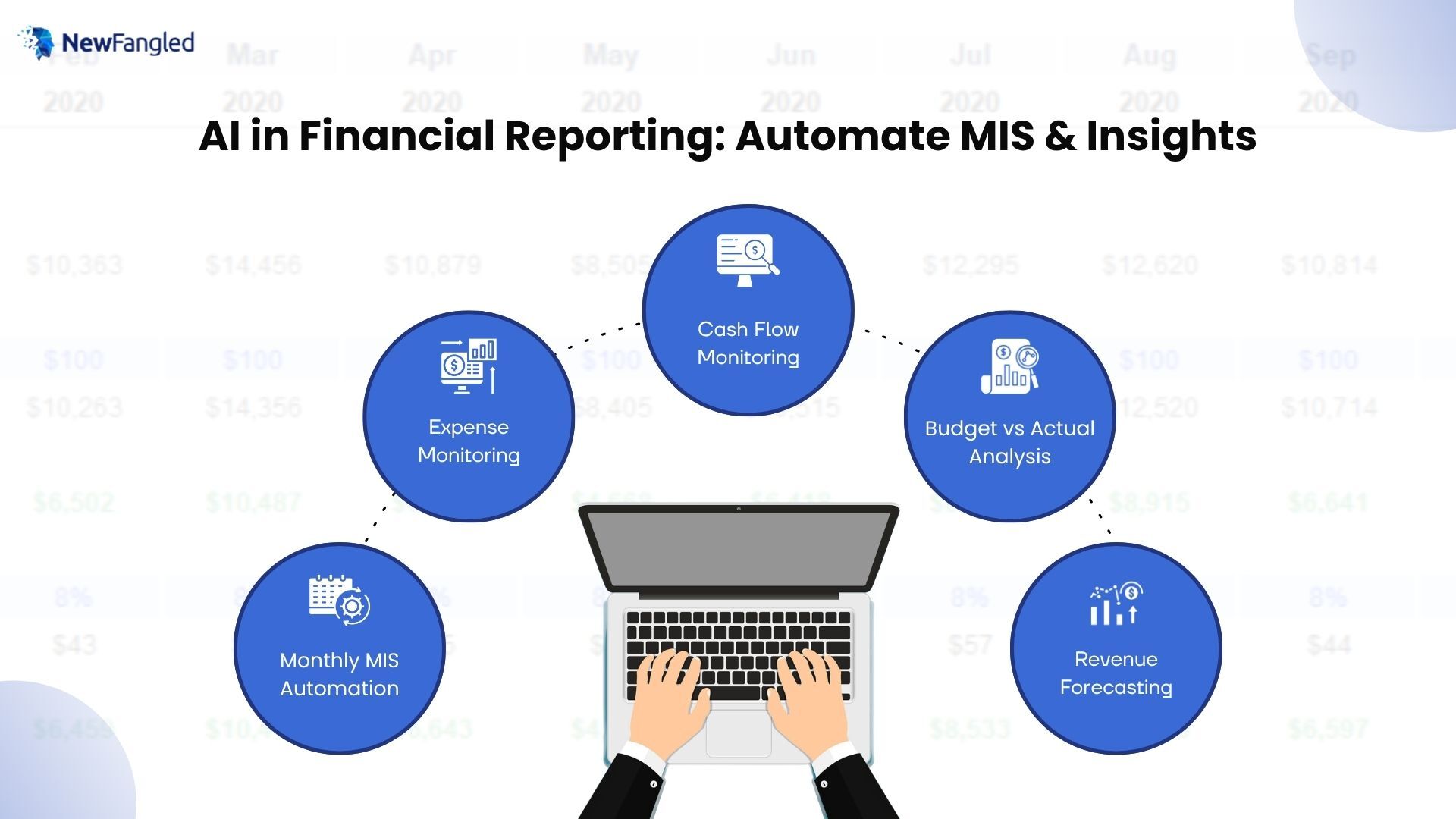
What does AI in Financial Reporting look like?
The main idea behind it is to employ AI technologies to make financial reporting work better and more automated. This includes:
- Automating the process of gathering data from Excel, ERP, and CRM apps.
- Automatically making MIS reports
- Making dashboards that provide financial information in real time.
- Giving information without having to analyse it by hand.
AI-powered solutions process data all the time and modify results in real time, unlike traditional reporting systems.In short, people who work in finance no longer have to make reports by hand. Instead, they can focus on making choices and comprehending facts.
Challenges with Traditional MIS Reporting
Even though technology has come a long way, a lot of businesses still use old reporting systems. These systems make things less efficient, which makes it harder to scale and make decisions.
Some common problems are:
- Putting together data from different platforms by hand
- A lot of dependence on IT or analysts to make reports.
- Processes that take a long time and can take days or weeks.
- Errors and inconsistencies in data that happen when it is handled by hand
- Not being able to see how well the finances are doing in real time.
- Making decisions late because of old data
These limitations make it hard for finance teams to do their jobs well in fast-changing company settings. These problems get worse as businesses grow.
How AI in Financial Reporting Automates MIS Reporting
An organised procedure can help us understand how AI can change things. AI makes reporting easier by automating every step of the process.
1. Data Integration
AI solutions work well with many different types of business data sources, such as ERP systems, CRM platforms, databases, and Excel sheets. For instance, a finance team used to have to spend days putting together sales, expenses, and operating data from multiple platforms. When AI is used, all data is automatically combined into one display in real time.
This gets rid of the need to manually extract data and makes teams less dependent on each other.
2. Automated Data Processing
AI systems clean, normalise, and organise the data for analysis after it has been added. This means getting rid of duplication, fixing inconsistencies, and making sure that formats from diverse sources are the same. For example, AI automatically standardises the data to make sure it is correct before reporting. This means that people don’t have to check to see if there are any inconsistencies within departments.
This method makes sure that financial reports are based on data that is reliable and consistent.
3. Report Generation
AI takes care of making MIS reports, so you don’t have to do it by hand. As fresh data comes into the system, reports are updated on a regular basis. It used to take 3 to 5 days to make monthly MIS reports. Now they can be made in hours, if not real time, without any help from people. This cuts down on reporting cycles by a lot while making responses faster.
4. Insight Generation
AI can do more than just report; it can also find patterns, outliers, and key performance indicators. AI can also find unusual spikes in spending or falling revenue patterns and let financial professionals know they need to act quickly. This makes finance teams less focused on creating reports and more focused on analysing data and making strategic decisions.
In general, AI in financial reporting changes MIS reporting from a human, reactive process to an automated, smart system that helps people make choices faster and with more information.
Key Benefits of AI in Financial Reporting
The impact of AI is significant, especially for enterprise-scale operations where speed, accuracy, and visibility directly influence decision-making and financial outcomes.
Faster Reporting
Because of the need to manually combine data, traditional MIS reporting methods usually take 2 to 5 days. AI makes it possible to write reports in real time or in a few hours, which cuts reporting time by 60% to 80%.
A finance team automated the monthly MIS, which cut the time it took to make reports from three days to a few hours. This made it possible for management to make decisions more quickly.
Reduced Manual Effort
AI takes care of boring tasks like pulling data, reconciling it, and making reports. This can assist cut down on manual work.
Instead than spending time making spreadsheets, finance teams may focus on creating strategies and analysing variances.
Real-Time Financial Visibility
Dashboards driven by AI give you constant updates, giving you full real-time visibility into how your finances are doing.
CFOs can keep an eye on cash flow, sales, and expenses in real time, for example, instead of waiting for reports at the end of the month.
Improved Accuracy
Errors often happen when things are done by hand. By automating validation and data standardisation, AI-powered systems can cut down on mistakes in reports.
Automated reconciliation makes sure that all departments and business units have the same and precise financial data.
Smarter Decision-Making
AI can automatically find trends, outliers, and key performance indicators, which lets you make decisions before they happen.
Early on, artificial intelligence can find unexpected expense surges, which lets people take action right away.
Enhanced Data Control and Security
Centralised systems make governance and risk management better, which leads to more compliance and less access to financial data.
AI changes finance teams from people who make reports to people who help make strategic decisions, which improves productivity, accuracy, and business impact.
Real Use Cases of AI in Financial Reporting
The practical value of AI becomes most evident when applied to real enterprise scenarios. Across organizations, finance teams are moving away from manual reporting toward automated, real-time systems that improve both efficiency and decision-making.
Monthly MIS Automation
A growing company’s finance division mostly used manual procedures to make monthly MIS reports. Data had to be taken from many systems, put into spreadsheets, and validated before it could be reported. This process normally takes three to five days, which means that leadership assessments are put on hold. The company automated the whole MIS process by adding AI-driven reporting. We took data straight from ERP and financial systems, processed it automatically, and turned it into reports that were ready to use. The finance teams stopped making reports and started analysing them.
Result:
- Reporting time went down by 60–70%.
- No need for manual consolidation
- Shorter cycles for closing finances
Budget vs Actual Analysis
An organization had trouble seeing their budget and actual performance on time. At the end of each reporting cycle, variance analysis was done by hand, which made it impossible to take action quickly. The company employed AI to keep track of how well its finances were doing in real time compared to its budgets. The system always matched actual spending and revenue to estimates, so any differences were found right away. Instead of responding late, teams could take action ahead of time.
Result:
- Finding differences right away
- Making decisions to fix things faster
- Better money management
Cash Flow Monitoring
It was hard for a growing company to keep track of cash flow across its numerous business units. Because finance teams didn’t have a single, real-time view of inflows and outflows, they weren’t able to manage liquidity as well as they could have. AI-enabled financial reporting made it possible to keep an eye on cash transactions between accounts and platforms all the time. Dashboards are updated in real time, so you can see clearly how much cash you have. CFOs have a better handle on working capital.
Result:
- Seeing cash flow in real time
- Better planning for liquidity
- Less danger to your money
Revenue Forecasting
A company had a hard time correctly predicting its income since it used static models and old data. Forecasts often did not take into account how the market was changing.The company used AI-based predictions to look at trends in past data, customer behaviour, and outside factors. As new information came in, the forecasts were often changed. Forecasting changed from making static guesses to making dynamic predictions.
Result:
- 20 to 30 percent more accurate forecasts
- Financial planning that is more reliable
- Better fit with the company plan
Expense Monitoring
An company had rising running costs but didn’t know how people spent their money. Manual tracking makes it harder to spot inefficiencies or outlier expenses. AI systems kept track of spending in real time, found unusual patterns, and automatically flagged transactions that seemed suspect. Finance teams should do a better job of keeping costs under control.
Results:
- Finding cost problems early on
- Better control over costs
- Cut down on spending that isn’t essential
These examples show that AI is more than simply automation; it also lets you see everything all the time, make decisions faster, and have more control over your money. Modern workplace AI platforms make it easy to use these features together, so finance may become a strategic job instead of a complicated manual one.
Manual MIS vs AI-Based Financial Reporting
A comparison highlights the advantages of AI in financial reporting over traditional methods:
| Feature | Manual MIS | AI-Based Reporting |
| Speed | Slow | Real-time |
| Accuracy | Error-prone | High accuracy |
| Effort | High | Minimal |
| Insights | Limited | Automated |
| Scalability | Low | High |
Conclusion:
The development of AI in financial reporting is changing the way finance teams work. What used to take a lot of time and be done by hand is now done automatically, in real time, and with data. Businesses that still utilise archaic ways of reporting will have a hard time keeping up with the growing complexity. On the other hand, businesses that use AI-powered solutions make decisions faster, more accurately, and with less work.
This change is already clear at NewFangled Vision. AI-powered solutions let financial teams do more than just report; they can focus on what really matters, which leads to smart, well-thought-out choices.


I work at NewFangled Vision, a 6-year-old private GenAI startup from India. We build enterprise-grade AI systems without large LLMs or heavy GPU dependence, with a mission to make AI a seamless, must-have capability for every organization—without complexity or hassle.