

Table of Contents
Do You Really Need a Data Warehouse Before AI? A CXO’s Guide
Introduction:
Across enterprises, AI is no longer a question of if, it’s a question of when and how fast. Yet many organizations find themselves stuck at the starting line. They are waiting. Waiting for a data warehouse to be built and also Waiting for data to be centralized. Waiting for the “perfect foundation.” Months pass. Sometimes years.
In the meantime, competitors are already experimenting, learning, and improving decision-making through AI. The reality is simple: Waiting for a data warehouse could be delaying your AI advantage.
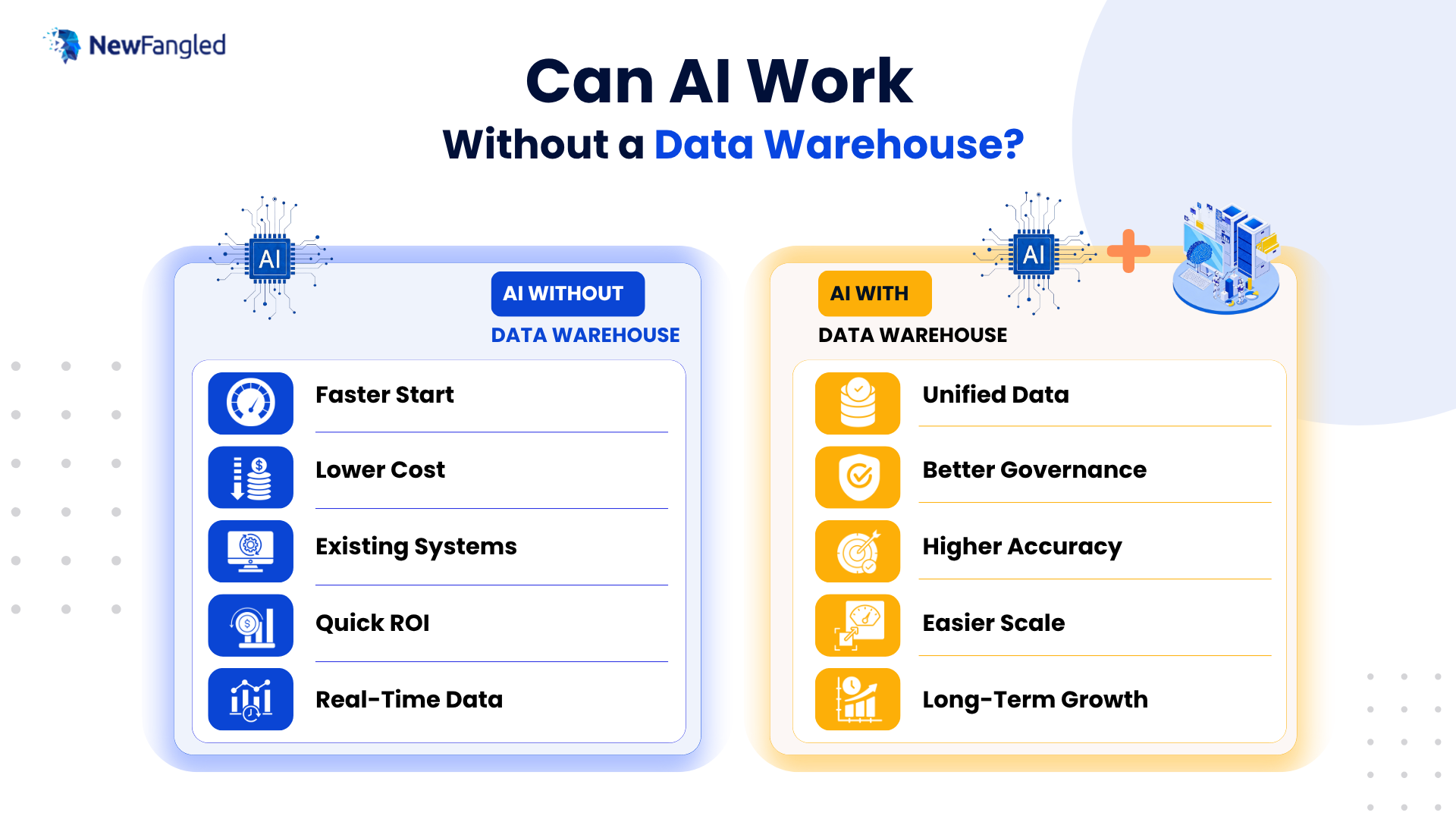
The Common Assumption: Data Warehouse First, AI Later
1. The Traditional Enterprise Approach
For years, the standard approach has been clear:
- Build a centralized data warehouse
- Clean and standardize all data
- Then apply analytics and AI
This model prioritizes infrastructure before value.
2. Why This Thinking Persists
It is based on legacy systems and traditional data architectures. Ecosystems of tooling and vendor strategies that promote centralisation have reinforced this.
3. The Problem with This Approach
This is a logical sequence but raises an important issue: It delays results. Organisations spend a lot of money on infrastructure that doesn’t immediately deliver business value.
Why Data Warehouse Projects Take Time
- Complex System Integration : Enterprise data is distributed across ERP, CRM, finance systems and operational databases. And it’s hard to put them all in one data warehouse.
- Long Implementation Cycles: Most data warehouse projects take 6-18 months depending on scope.
- High Capital Investment : It includes the costs of technology, data engineering teams and ongoing maintenance. Delayed Time to Value The 800lb gorilla is not cost, it’s timing. Infrastructure first thinking delays business impact”
The Risk of Waiting for a Data Warehouse
- Lost Time to Value: While infrastructure is being built, no meaningful insights are generated.
- Slower Decision-Making: Without timely insights, decisions rely on outdated or incomplete data.
- Competitive Disadvantage: Organizations that delay AI adoption fall behind competitors who move faster.
- A critical insight: A delayed insight is a delayed decision—and often a missed opportunity.
The Shift: AI Is a Use Case Problem, Not an Infrastructure Problem
From Infrastructure-First to Value-First :
Modern enterprises are shifting focus from systems to outcomes. AI is not implemented to build infrastructure—it is implemented to solve problems.
Connected Data vs Centralized Data:
A data warehouse centralizes data. Modern AI connects to data. Instead of moving everything into one place, AI systems integrate directly with existing sources.
Modern AI Data Integration Capabilities
Today’s AI platforms can connect to:
- ERP systems
- CRM platforms
- Excel and spreadsheets
- Databases
- APIs
This enables faster access to insights without full data centralization.
What AI Can Do Without a Data Warehouse
A common misconception in enterprise AI strategy is that you need to have a fully built data warehouse in order to gain meaningful insights. Centralisation has its benefits, but modern AI systems do not have to be centralised to deliver value.
Today’s AI can work well with connected, distributed data, so organisations can move quickly without waiting on large infrastructure projects.
Direct Integration with Enterprise Systems
Today’s AI platforms can connect directly to core business systems such as ERP, CRM and operational databases. Rather than moving data to a central warehouse, AI can access data in place. This means that no manual consolidation is needed anymore and delays are reduced considerably.
For example, sales teams can query performance data from CRM systems, finance teams can query transaction data from ERP systems – all without waiting for data pipelines to be built.”
Impact:
- Quicker insights access
- Reduced reliance on data engineering teams
- You can use existing data immediately
Working with Excel and Operational Data
Many organisations still depend heavily on Excel and spreadsheets for day-to-day operations even after investing in enterprise systems. Modern AI tools are built to work with these formats without a hitch. They can ingest, process and analyse spreadsheet data without the need to move it into a structured data warehouse.
This is especially useful for functions such as finance, operations and reporting, where Excel continues to be a primary data source.
Effect:
- Builds on existing workflows
- Eliminates the need for manual analysis
- Speeds reporting and insights
Real-Time Data via APIs
Traditional data warehouses are usually updated in batches data is updated at regular intervals (e.g., daily or weekly). By contrast, AI systems can connect to data sources via APIs, which enables them to access data in real-time.
No longer will organisations have to wait for updates. Instead they can watch performance, detect changes and respond immediately. For example, a sudden dip in sales or spike in costs can be detected as it happens, not after a reporting period.
Impact:
- Real-time visibility
- Faster response to changes
- Improved decision velocity
Generating Insights Without Full Centralization
Perhaps the most important capability is this: AI can generate insights without requiring all data to be in one place. By analyzing distributed data sources, AI can identify patterns, detect anomalies, and provide recommendations even when data is not fully centralized.
This approach allows organizations to start small, focus on specific use cases, and scale over time.
Impact:
- Faster time to value
- Incremental adoption of AI
- Reduced upfront investment
Real Enterprise Use Case: Faster Financial Reporting Without a Data Warehouse
Consider a regular enterprise finance team that has to prepare monthly MIS reports. The process is well known data is extracted from ERP systems and merged with Excel-based inputs, validated across multiple sources and then combined into final reports. The organization has the data to automate but has decided to put that automation off. Why? They’re waiting for a centralised data warehouse to be built before they embark on any AI-driven reporting.”
Data extraction is still manual. Teams spend hours pulling information from various systems. Consolidation occurs in spreadsheets and often requires multiple iterations to fix inconsistencies. Validation adds time, especially when we get differences between the systems.
This means that reporting cycles take days to complete. By the time MIS reports are prepared, the information is old news. Leadership is forced to make decisions based on outdated information, reducing responsiveness to changing business conditions.
The Shift: AI Without Waiting for a Data Warehouse
Consider a regular enterprise finance team that has to prepare monthly MIS reports. The process is well known data is extracted from ERP systems and merged with Excel-based inputs, validated across multiple sources and then combined into final reports. The organization has the data to automate but has decided to put that automation off. Why? They’re waiting for a centralised data warehouse to be built before they embark on any AI-driven reporting.”
In the meantime, the current process goes on. Data extraction is still manual. Teams spend hours pulling information from various systems. Consolidation occurs in spreadsheets and often requires multiple iterations to fix inconsistencies. Validation adds time, especially when we get differences between the systems. By the time MIS reports are prepared, the information is old news. Leadership is forced to make decisions based on outdated information.
Business Impact
The results are strategic and measurable:
- Reporting cycles are reduced by 60-70% from days to hours
- Leaders gain insights more quickly, with decision-making speed improved by 30%.
- manual effort is reduced considerably so finance teams can focus on analysis instead of data prep
Most importantly, the organization starts to see value immediately, before long-term infrastructure projects are completed. Meanwhile, they continue to shape their data warehouse strategy, now based on real usage and needs.
Key Insight
An AI-first strategy, on the other hand, focuses on delivering value early and scaling over time. Organisations begin with some use cases such as financial reporting and achieve quick wins. These early wins provide immediate ROI and build momentum for broader adoption.
Value is created through iteration not through a big upfront investment. It’s a strategic, as well as a technological, shift. It’s not about driving down cost, it’s about accelerating value,’
Companies that prioritise speed over perfection in their infrastructure can move faster, learn faster, and ultimately build better systems.
Conclusion: It’s Not About Skipping It’s About Timing
A data warehouse is not unnecessary. It is essential at the right time. Enterprises that delay AI until infrastructure is complete risk losing valuable time and opportunity.
Those that start with use cases can generate value early, learn faster, and build better systems over time. The future of enterprise AI will not be defined by who builds the best data warehouse. It will be defined by who turns data into decisions the fastest.


I work at NewFangled Vision, a 6-year-old private GenAI startup from India. We build enterprise-grade AI systems without large LLMs or heavy GPU dependence, with a mission to make AI a seamless, must-have capability for every organization—without complexity or hassle.